

The big question in natalism is about whether birthrates fall, primarily, because of culture. Or whether they fall because of economic factors.
The argument for culture goes something like this; “most of our great grandmothers gave birth to several children, in two room shacks, and couldn’t afford a spare pair of shoes. We are richer than we’ve ever been. There is no way that people can’t afford to have children. We simply have other priorities now.”
The argument for economics is something like this; “children are as valuable as they have always been, but as we get richer the value of work and leisure has improved so much. And while we have washing machines and epidurals, children still take up a career’s worth of time and effort. People see this and then they invent rationalisations for why they don’t want as many children as their ancestors. Culture is downstream of economics here.”

In my last post I wrote about how European countries with more socially conservative beliefs actually have lower birth-rates than those with socially liberal beliefs. That may sound like I’m making a contrarian and counterintuitive argument for Team Culture but I am incredibly suspicious of all stories about how being socially liberal could lead to more children.
My best guess for why socially liberal societies could have higher birth-rates would be a general endorsement for the left. I’d say that people in socially liberal countries are happy and people are like pandas – they only make babies if their lives are good. But that sounds like bullshit to me.
So let’s examine the data more closely.
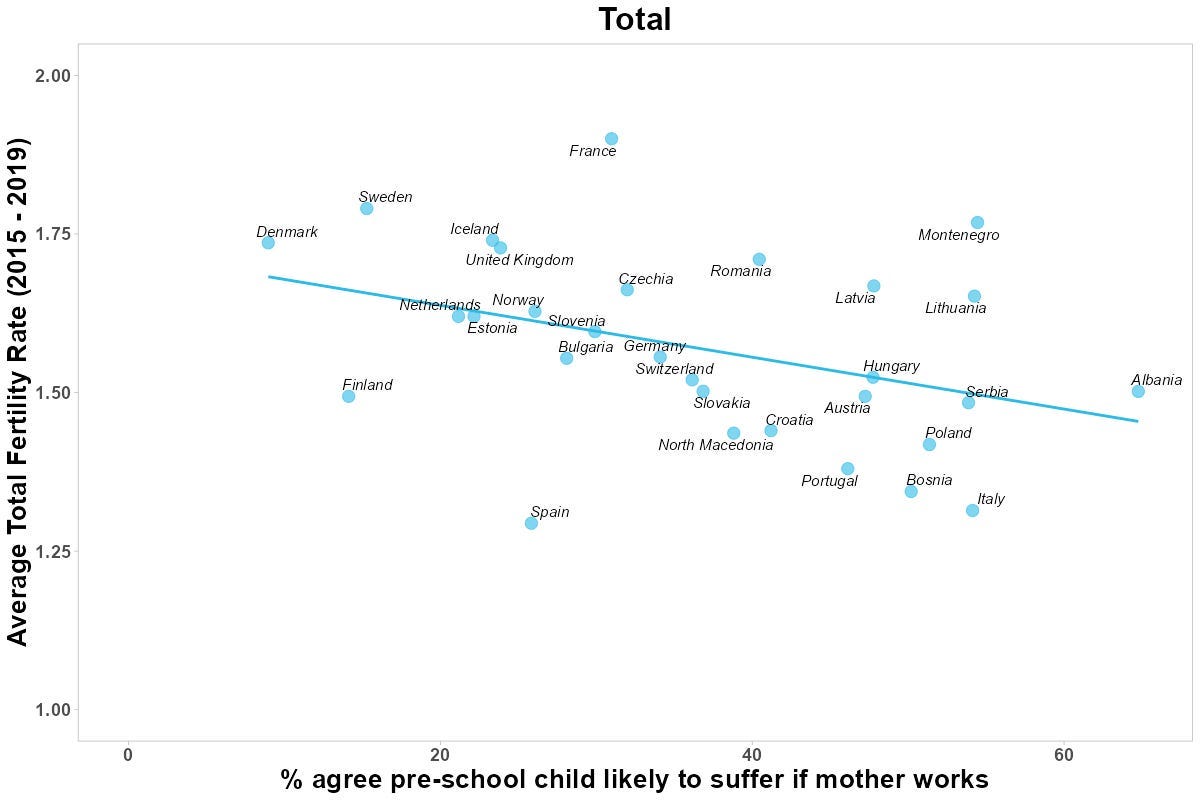
This is the strongest trend Boom found in Europe. Of the social values checked, the more people believed that a pre-school child suffers if their mother works, the fewer children they had.
The trend is sufficiently weak, and Europe is sufficiently small and similar to itself, that I thought it could be a weird fluke. I thought that maybe Scandinavian countries are very socially liberal but also have very generous pro-parent welfare policies, which means they could disrupt the rest of the data.
So I thought that before coming up with explanations, it was worth checking to see if the trend exists globally.
I have decided to compare the OECD numbers for fertility with the World Values Survey questions, to see if this trend persists.1

This graph matches the European trend. I now think it is safe to say that, in the rich world, if your people believe that a working mother somehow harms her children, this means you will have lower birth-rates. It seems that moving from this being a fringe opinion to being something most people believe, loses you one baby for every four women.
So why might this be the case?
Childcare
If most of your fellow countrymen believe that young mothers should be at home with their children, then there will be less political support for generous childcare subsidies. “Really, childcare is only used by work-a-holic harridans so why should we help them?”
But this doesn’t hold up.

Surprisingly it turns out the cost of nursery schooling has basically no impact on TFR. Austria and Switzerland have a lot in common, but in Vienna your nursery costs you 3% of your income (at that point, why charge at all?) and in Zurich it will cost you 64% – regardless you’re going to have the same number of kids.
Because countries offer very different benefits for different subsets of the population, schools start at different ages, and parental leave policies vary so much, it is difficult to get a real country by country comparison. Nonetheless, these OECD numbers seem to be the best on the market.
I’ll go into more detail about childcare policies at some point. But for now, I am unsatisfied by the childcare argument.

Weirdly, in countries where people think nurseries are bad for small children, nurseries are cheaper. (But this is a very weak correlation.)
Social pressure
Maybe the cost of childcare doesn’t really tell you much about whether people use it. In Vienna, maybe you think about dropping your child off at their cheap nursery but you can’t bring yourself to do it because you think you’re inflicting debilitating trauma on them.
While childcare may technically be very cheap, it could be too shameful and emotionally taxing to use it, so actually the cost of having two children isn’t 3% of your income, it’s actually 100%.

But there also appears to be no relationship between the number of under twos in childcare and TFR. Nor, it seems, is there any relationship with the proportion of mothers of under-twos who work and TFR.

This implies to me that it’s not really about the cost of taking care of children at all.
Hard work
If you think a child suffers from being away from its mother, you probably believe one of two things. First, there is a sacred bond between mothers and babies, and the infant is somehow psychologically damaged if they spend too much time apart.
Or, you believe that small children require a lot of attention to develop properly and there is no way to practically provide that if there are lots of children and only a few adults. And that paid workers, while able to ensure that a child eats, sleeps and doesn’t electrocute themselves, they are probably not sufficiently motivated to continually stimulate an infant in the ways that are best for brain development.
If you believe either of these things, then you probably don’t think that you can have a new baby if you already have another young child in the house because you will, by necessity, be depriving the older child of their mother’s attention.
What data can you use to test whether people think children are a lot of work? The best thing I found was the amount of time that the mother spends on care.

Now we’re starting to get a graph that looks like the first one. This could be a plausible mechanism.
Maybe it is economics after all …
This third idea seems somewhat compelling to me. Especially because the belief that when a mother works, the child suffers, has a stronger relationship with TFR than other socially conservative beliefs about women and work.

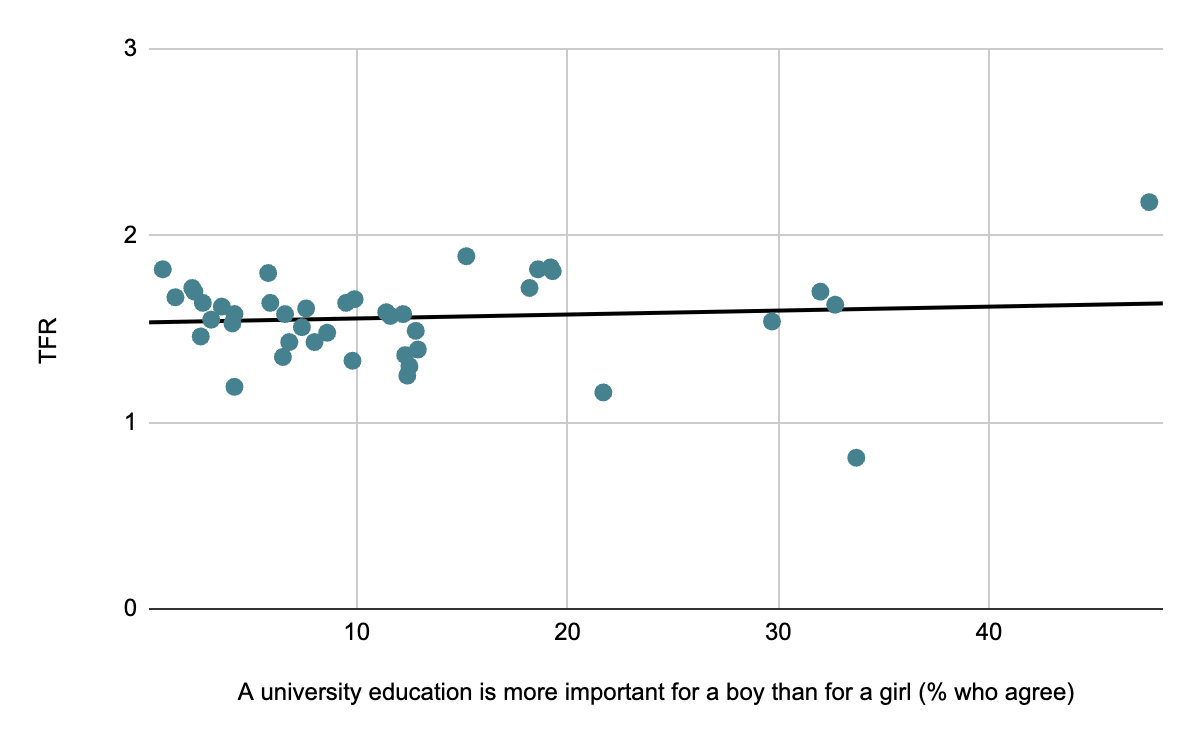
Is this a victory for team economics? Countries where mothers spend more time with babies have fewer babies – that’s not proof by any means, but it sure seems like a clue about what’s going on. It indicates that the more effort children are, the fewer children get made.
But, the effort needed to raise kids is not determined objectively. Polish mothers aren’t spending twice as much time with their kids than Belgian mothers because their babies are inexplicably more difficult. There are cultural beliefs that underpin what’s happening.
It is easy to believe that the world is progressing from conservatism to liberalism – and that if generations change their minds about something, it must be because they believe the more liberalism-y thing.
But actually, beliefs can change for other reasons too. Not everything is about the culture war. For some reason, we’re tending towards an era of baggy jeans (again), and that has nothing to do with how woke people are (and don’t let some click-monger working in the Conde Nast mines tell you otherwise). Cultures reimagine the world all the time for all kinds of reasons, “woke” being just one of them.
In this particular case, I think the birth-rate-destroying belief is not really a conservative belief about women and gender. It is actually a belief about babies. My guess is that if the World Values Survey asked whether “It takes a lot of work to raise a child well”, then we would find an even stronger correlation.
The OECD records data on a few rich-ish countries both in and outside the OECD. The World Values Survey is rolling, so not everywhere has been covered in the post-2017 wave just yet. So not every country you think has been covered and there may be some surprising additions as well. The eagle-eyed among you will be quick to spot where Israel is included and where she isn’t.
What you present is not *the* economic explanation. A macro-economic explanation is the transformation of average daily life (via industrialization) from a labor-intensive to a capital-intensive process. We no longer labor in the forest and field where a large family with lots of children can provide greater labor output and older children offset the cost of raising younger ones - we are in a capital-intensive framework where the limiting factor to family size is parental income, older children are not deemed capable of correctly educating younger children, children cannot work to offset the costs of their own upbringing, and financial investment in formal education is necessary for socio-economic success.
As a Western European - I see immigrant families have a lot of unemployed relatives they can count on for support. They also have much different standards in terms of what they ought to do to raise the children (lots of unsupervised outdoor play from quite a young age, no pressure to be in all the extra-curriculars).
I've always wanted to have a big family but for me, despite having a high earning husband, it's expensive because any break I get I have to pay for - hire a cleaner, meal service, or babysitter. There's very little in the way of hand-me-downs from relatives because hardly anyone is having kids. And there is a lot of social pressure to do everything better than previous generations (which is a lot of work): break the intergenerational chain of trauma, provide evidence-based enrichment toys&activities, organize playdates with appropriate peers, dress them 'aesthetic', nurse on demand, on and on it goes. My grandma had 7 kids but she put the babies in the attic so she wouldn't hear the crying. And opened a window near the playpen rather than take them to the park. And she didn't lose sleep pumping for milk when my dad was a hungry baby, the greengrocers wife simply nursed him, too.
I try to be sensible (no shame in kids sharing bedrooms, second-hand clothes, or showering weekly rather than daily), but it's still a lot for someone with zero support. I could make it easier on myself by doing cry-it-out and letting the streets raise my kids and bottle feeding, but am unwilling to accept the risks that go with that. And we've had to reinvent the wheel in terms of how to raise a child, because while we are aware of some dysfunctional stuff we don't want to repeat, there's so much conflicting information about what the *right* way is it's exhausting. So my family size is a lot smaller than I would have liked.
Another factor - I see quite a lot of men who want families, but in stead of dating women who want children too, they date the prettiest girl they can find for years and years waiting and hoping she'll come around.
And as a SAHM, I've personally been directly insulted and demeaned for that choice by other women (both working mothers and childless) because it's considered very uncool and low social status to be SAHM. So while many people believe children are better off with a SAHM, SAHMs are seen as losers... It's hard to experience that kind of rejection.
Another one - it's considered very uncool and even irresponsible to have a big family by many. My brother had both sets of grandparents (who had bigger families themselves) react negatively when he announced his second (despite being married & well-off), and I've heard many comments about how I should not have more kids after my second. Another social rejection thing.
I've read somewhere that policies like giving parents money when they have kids have the most direct measurable effect in encouraging the dredges of society to reproduce (drug addicts, families already monitored by CPS, mentally disordered assisted living, all that) but there's not much effect on functional, healthy & more independent families.
I would have liked to have a much bigger family. For me what would have helped:
- more support from family (practically, like meal trains, hand-me-downs and babysitting) - that's the main thing
- less hatred/judgement from neighbors
- having a regular income at an earlier age (we only started having kids when that was in order)
- less conflicting information == more comprehensive evidence-based info on how to not repeat the sins of our fathers re: childrearing&trauma (especially necessary for us because we had a high needs profoundly gifted firstborn and it took a lot of figuring out how to handle him, now that we've got the hang of that we might have a few more in quick succession before my eggs shrivel up).