

Every time I tell people I have a ‘mathematical guide to settling’ they always ask me if it’s the secretary problem. Have I heard of the secretary problem? What do I think of secretary problem? Why isn’t my model at least somewhat based on the secretary problem? And on and on.
I first learned about the secretary problem when a maths YouTube channel (I was a very cool preteen) called it the festival loo problem. In the festival-loo-secretary-problem, your goal is to piss in the cleanest portaloo at a festival or hire the best secretary. You can only move forwards in the queue so once you have seen a toilet/interviewed a candidate and decided it is not to your liking, you can’t go back. Under those conditions, how do you maximise your odds of finding the best option?
I won’t bore you with the maths but basically you look at the first 37 percent of toilets and then use the one that is cleaner than the cleanest you have already seen.
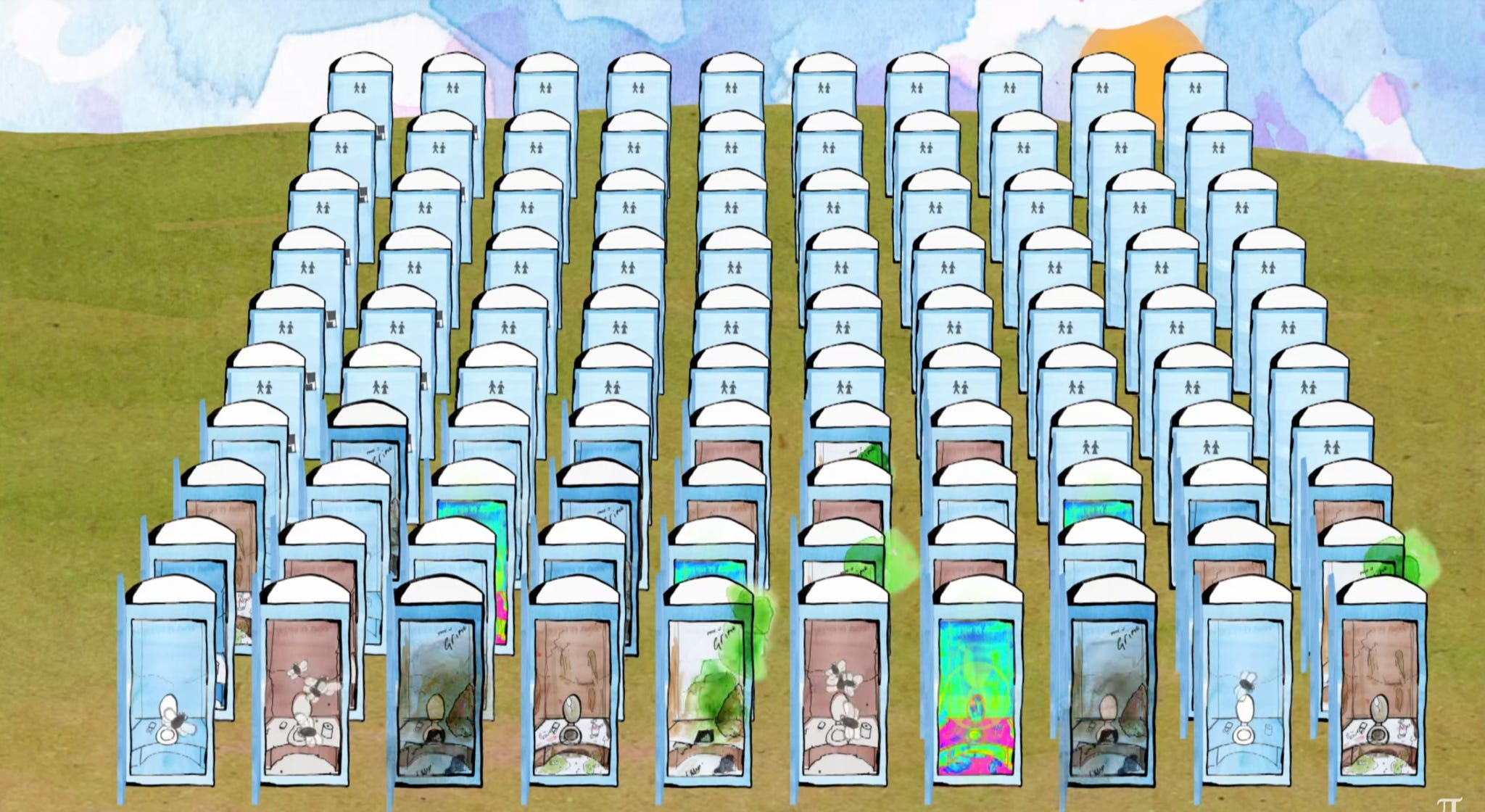
I think this is a bad model. First, as discussed, your odds of finding a good toilet decreases over time. Second, there’s a good chance you can go back. Third, there’s a 37 percent chance you get to the end of the hundred options and you have nothing. In a festival that’s not so bad, you can rejoin the queue. In life, you don’t want a 37 percent chance of ending up alone because you met your best possible partner at the beginning of your dating life. You’d probably take the second or third best option to minimise the downside risk of being secretary-less. Fourth, how are you actually meant to use this? How long do you have to date them to consider them properly checked? Are you meant to date one third of all the men in the world? Are you meant to pre-decide what your ‘dating window’ is and then psychopathically reject plenty of perfectly nice people because you’re just evaluating them?
I think people like to share this model because it seems systematic but it’s not actually very cognitively taxing – especially if you elide the explanation for why 37 percent is the number. It’s all the aesthetic of rationality without the annoying thinking part.
I think dating is better modelled as a game of blackjack. Each time you encounter a match – a potential date, a moment of flirtation that could lead to something, a romance that you could turn exclusive, a painful relationship you could recommit to or walk away from – you need to know if you can do better. Should you hit or stand?
Dating is a very messy problem. It’s difficult to have an objective sense of what is out there and what you can get. People are always lying to you and the most important traits take a lot of investment to find out about.
I have a formula that I think works but it is much more time consuming than the secretary problem. Hopefully I’ve convinced you that it’s worth putting some serious rational effort into your husband hunt. This will take about 30 minutes. If you’re genuinely serious about this, save this post and come back to it after you’ve booked out a block of time. Here’s the vibecoded website that can help you with your maths or, if you would prefer to tweak the maths yourself, you can use this spreadsheet as a template.
My apologies to all the people who are reading my blog because they are enjoying the circus and not because they are looking for a spouse.This one probably isn’t for you.
Is he out there?
You may have seen the Keeper delusion calculator where you say that you’re looking for a highly eligible man and then it reminds you that highly eligible men are rare. This is basically a version of that except I think it’s fine if the person you’re looking for is only 0.001% of the population. You just have to be well positioned to find that 0.001%. You only need one husband after all.
The first stage is working out the odds that the kind of man you want exists.
You should write down the trait you want and then guess at what proportion of people have that trait. It doesn’t need to be accurate, just a guess. If you want a little bit of support and you don’t have any numerate friends, ask an LLM.
Then move onto the next trait. Write that down and what proportion of people have that second trait given that they also have the other traits you’ve already written down. If you’re looking for someone who is an NBA player and also over 6ft you don’t need to multiply the proportion of NBA players by the number of men over 6ft. You can safely say that 99% of people in the NBA are tall enough.
When you’re done, multiply all your proportions together to get your final number of eligible bachelors.
Be careful to actually think about these proportions as they relate to the traits you’ve already written down. Of course, these numbers are made up. But, if it’s worth doing, it’s worth doing with made up statistics.
Briefly, here’s my case for using the made up numbers.
Made up numbers are better than randomly guessing without making up numbers. I also have some rules of thumb but I think this exercise is more helpful than those.
You’re forced to be realistic about your expectations. When I talk to women who are dating, their rationale for rejecting any individual man in abstract is reasonable, but their list of requirements in aggregate is somewhat delusional. You can dump a guy for being unattractive, having a bad sense of humour, having different values, because you don’t have any hobbies in common, or because you don’t like the same thing in bed. Each of those complaints, as a standalone, is reasonable. And if you’re really normal and really sexy you might be able to get away with a list like that. But if you want a really sexy boyfriend who also loves Stuart Lee, is the right amount of woke to make you feel like a good person but the right amount of conservative that you can complain about your annoying friend who won’t shut up about Palestine, goes mountain biking every weekend, and is an enthusiastic participant in your scat fetish then … well … I think you’re being a bit delusional.
The other side of this is that lots of women have been told that they need to lower their standards already. I think this causes some women to dither and give someone a chance when they don’t deserve it. If you haven’t clarified to yourself what you really want and what you’re willing to settle on, then you’ll waste a lot of time.
If you go through my system, you can make your tradeoffs intentionally. You may find now that you lower and raise your standards based on fluctuations in your self esteem. One of the main ways I find women wasting time is they are loss averse about a stand-out trait a man has, even if he lacks something else important. Say he’s really funny and charming but has a debilitating drug problem. Especially in the cases when you start to fall for someone, it is useful to have something concrete to hold onto while your instincts are confused. Don’t get dicknitised into a bad marriage.
Hopefully thinking about settling proactively now saves you from more settling later when your odds are worse and you’re in an ovarian-reserve panic.
I was originally going to share my list of requirements as a toy model, but upon reflection it’s private and I am older and wiser now, so instead let’s use my husband’s characteristics, as described in the first post, as our toy model. Here is my rough calculation.
A single man in London, aged 22-35. 1 million.
Oxbridge – 23,800
Good earning potential. Let’s say earning £75k by their late twenties. (I would have assumed that basically everyone from Oxbridge was on-track to earn a lot but now I know people go and work for charities/the arts/the public sector or become long-term NEET), so – 70%.
Lots of friends – 75%
Some of those friends are women (a proxy for respecting women) – 80%
Good relationship with his family (a proxy for being emotionally well adjusted and a man of honour) – 90%
A good person (I have quite a high bar for the kind of person I think is morally good enough to spend your life with. I think I needed someone who was intuitively loyal, naturally compassionate, and has enough of a backbone to resist social pressure.) – 20%
Good relationship skills (I think after filtering on good relationships with friends and family, basically everyone would pass this bar.) – 100%
Wants children – 60%
6ft1 (or above) – 30%
In shape – 80% (These numbers are quite high, because this is now a very filtered group)
Handsome – 40%
Reads and is generally cultured and knowledgeable – 80%
Has hobbies – 90%
No mental health problems – 95%
No physical health problems – 90%
All his grandparents lived into their 90s – 1%
Good general social skills (Considering we’ve filtered for professional and social success, I consider this one to be covered) – 100%
Masculine – 80%
Good at being romantic – 25%
From these back of the envelope calculations, it seems like the odds of my husband existing are about 1 in 10. To be fair, he is the only person I know who meets these standards and, having run through the process with lots of people, I now have an intuitive sense of what unreasonably high standards look like. I was only looking for some of these traits and I lucked into the others.
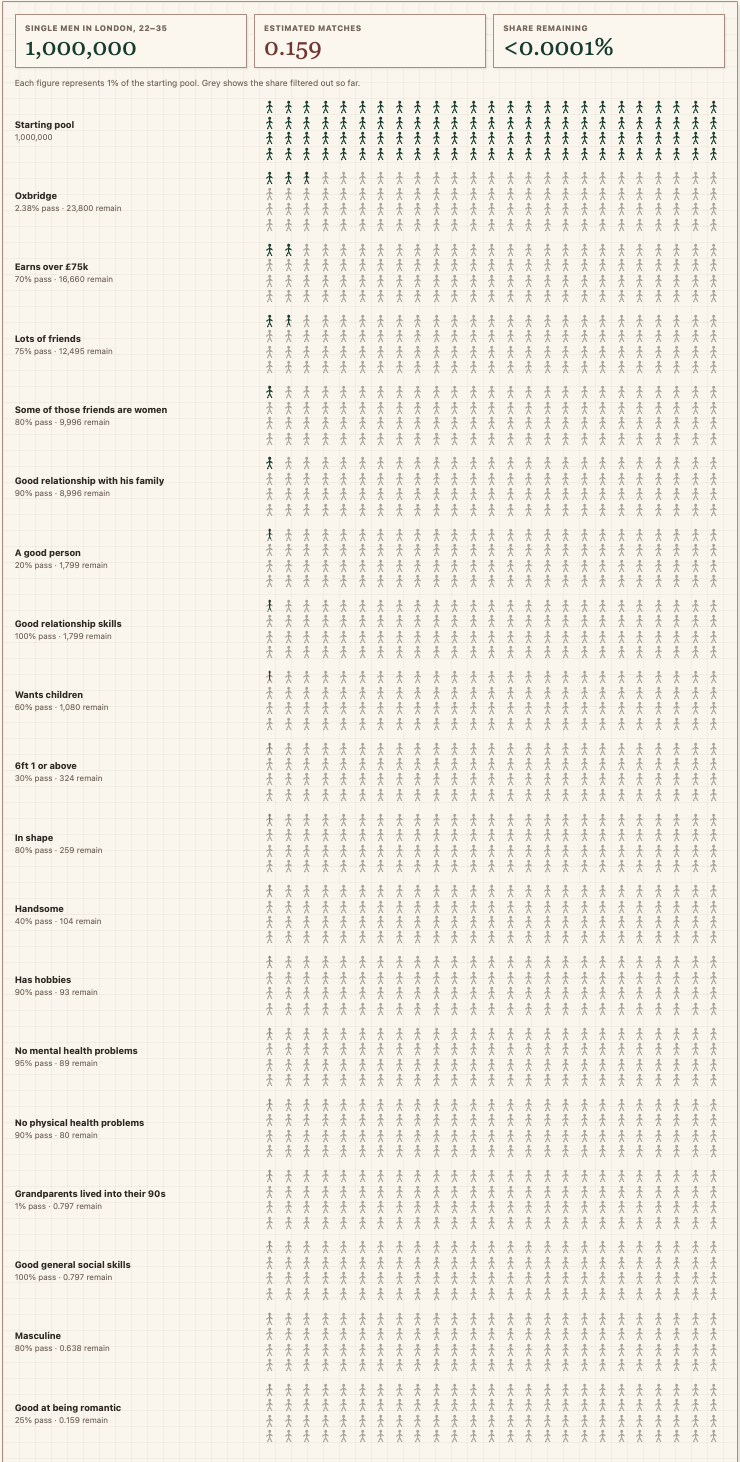
My rule of thumb for validating these results is to ask yourself if you know anyone who meets your requirements. If you don’t, it’s a sign that some of the traits you want are anti-correlated for reasons you’ve overlooked or perhaps a sign that people like that don’t mix with people like you.
I have three friends who seem to meet all these requirements except for the grandparent thing (I asked) and maybe the romantic thing (how would I know?). That makes sense. Axing just those traits increases the pool by 400 times – up to a more realistic size.
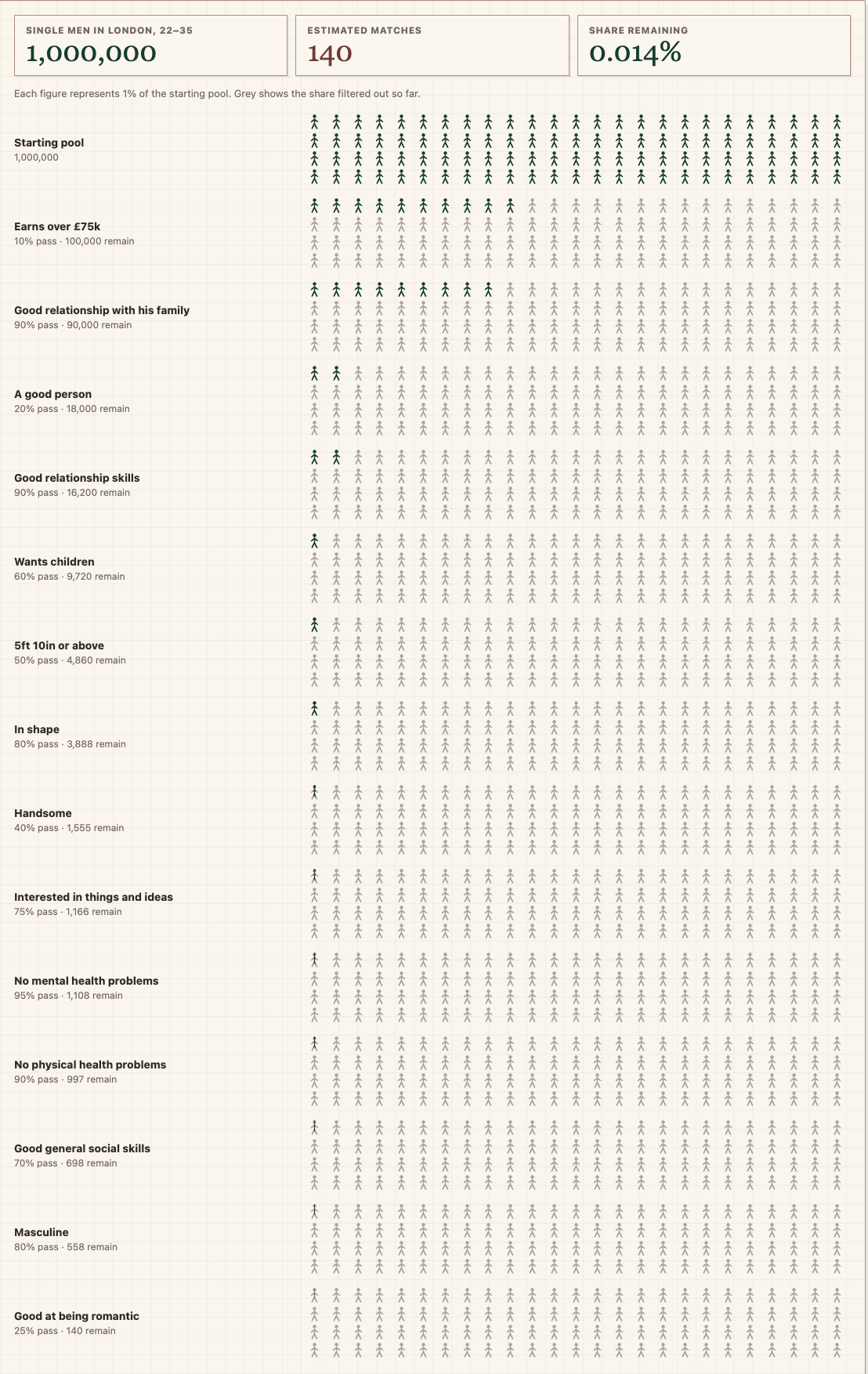
If I were compiling this list again, I would lower my standards to something with a more realistic shape.
A single man in London, aged 22-35. 1 million.
Good earning potential. Let’s say earning £75k by their late twenties –10%
Good relationship with his family – 90%
A good person – 20%
Good relationship skills (Now I’m no longer filtering for having lots of friends I think some people might fall afoul of this) – 90%
Wants children – 60%
5ft10 (or above) – 50%
In shape – 80%
Handsome – 40%
Interesting in things and ideas – 75%
No mental health problems – 95%
No physical health problems – 90%
Good general social skills – 70%
Masculine – 80%
Good at being romantic – 25%
This now gives me 140 potential husbands and loads of eligible friends. This is a number we can work with.
After you make this list, have a good think about whether there is anything you couldn’t live without. People need all sorts of things from their partner that I haven’t included here. You should think about
Religious affiliation
Political affiliation
Sexual proclivities
Emotional hang ups
Things that have ruined past relationships
Your League
After that, you have to work out what proportion of these people you can get.
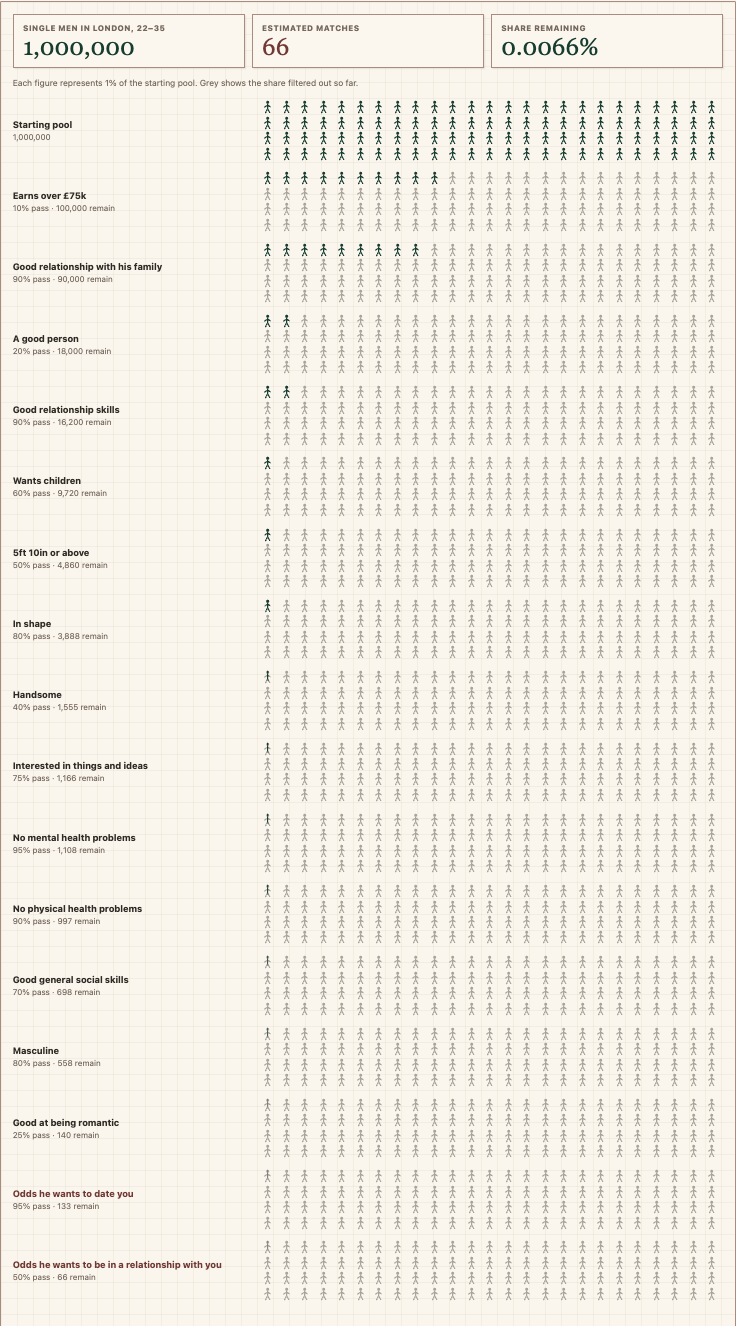
Women often have their epistemics tampered with by men who are willing to sleep with them but find them too unattractive to make his girlfriend. These guys will date a woman and give her some portion of the ‘boyfriend experience’ while they are fundamentally unwilling to commit to her in any substantial way. For this reason I think you should have two different estimates; first, the proportion of people who meet your requirements who want to date you and second, the proportion of those people you expect to want to be in a relationship with you.
I can’t give general advice here because your personal league depends on so many idiosyncrasies. I kept a spreadsheet of everyone I went on a date with so I have my stats. My numbers indicate that about 95% of people in my pool would be attracted to me and about 50% of those people would still want to go out with me after we got to know each other.
My starting advice is that you should go through your calendar and your dating app message history and try to make an estimate based on all your past situations. Going forward, actually gather the data. Record every person you meet. Keep a tally of whether they meet your requirements and who rejected who (and your best guess as to why).
I’ve made this spreadsheet and you can make a copy and use it for your own record keeping.
This is hard. Most people aren’t strong enough to look directly at their romantic rejections and accept them for what they are without embellishment — ‘we both weren’t feeling it’, ‘it’s because he’s threatened by strong women’, ‘he’s not in a good place emotionally right now’. Everyone is always making excuses and playing down their investment when a situation turns sour. If you can see that you were rejected and why, you can use that information to adjust your strategy.
So, to continue with our toy model this gives me 67 potential husbands.
Building a dating calendar
Now that we’ve clarified how delulu you’re allowed to be, we need to work out what you need to do to hunt down this man.
For each of the traits that you want, group them into buckets of how long it takes to find out if he has it. I was using apps to date, so most of this will be through the lens of matching with someone on Hinge. If you’re religious, you can assume that you’ll do most of your husband hunting at a place of worship and everyone you meet is pre-filtered on religion. If you’re meeting people via a matchmaker, they can do oodles of pre-filtering for you. If you’re always meeting people at bars or house parties, you might not know their basic biographical information before going on a date, but you’ll know more about their general vibe and your chemistry.
Clear before a date
Single
Man
Age 22-35
Good earning potential
5ft10
In shape
Handsome
Clear after one date
Wants children
Interested in things and ideas
Good general social skills
You have to get to know someone to know (about 3 months of dating)
Good relationship with family
A good person
Good relationship skills
No mental health problems
No physical health problems
Has masculine virtue
Good at being romantic
Continuing with this toy example, you should expect 32% of the people you go on a date with to be worth a second date. You can cut out a further 2% as not interested in you. That’s good. For every three or four dates you go on, you can expect one person to be worth seriously considering.
At a date per week, it should only take a month to find someone like that.
Of the people you’re considering more seriously, only 1.4% will be actual husbands. That means you’re going to need to properly date about 72 people to find a husband.
To meet your husband within the year, you would have to be dating about 18 people at a time, which doesn’t seem possible for anyone really. If you’re happy dating about three people concurrently, which I think is the absolute maximum most people can manage, it will still take you 24 years.
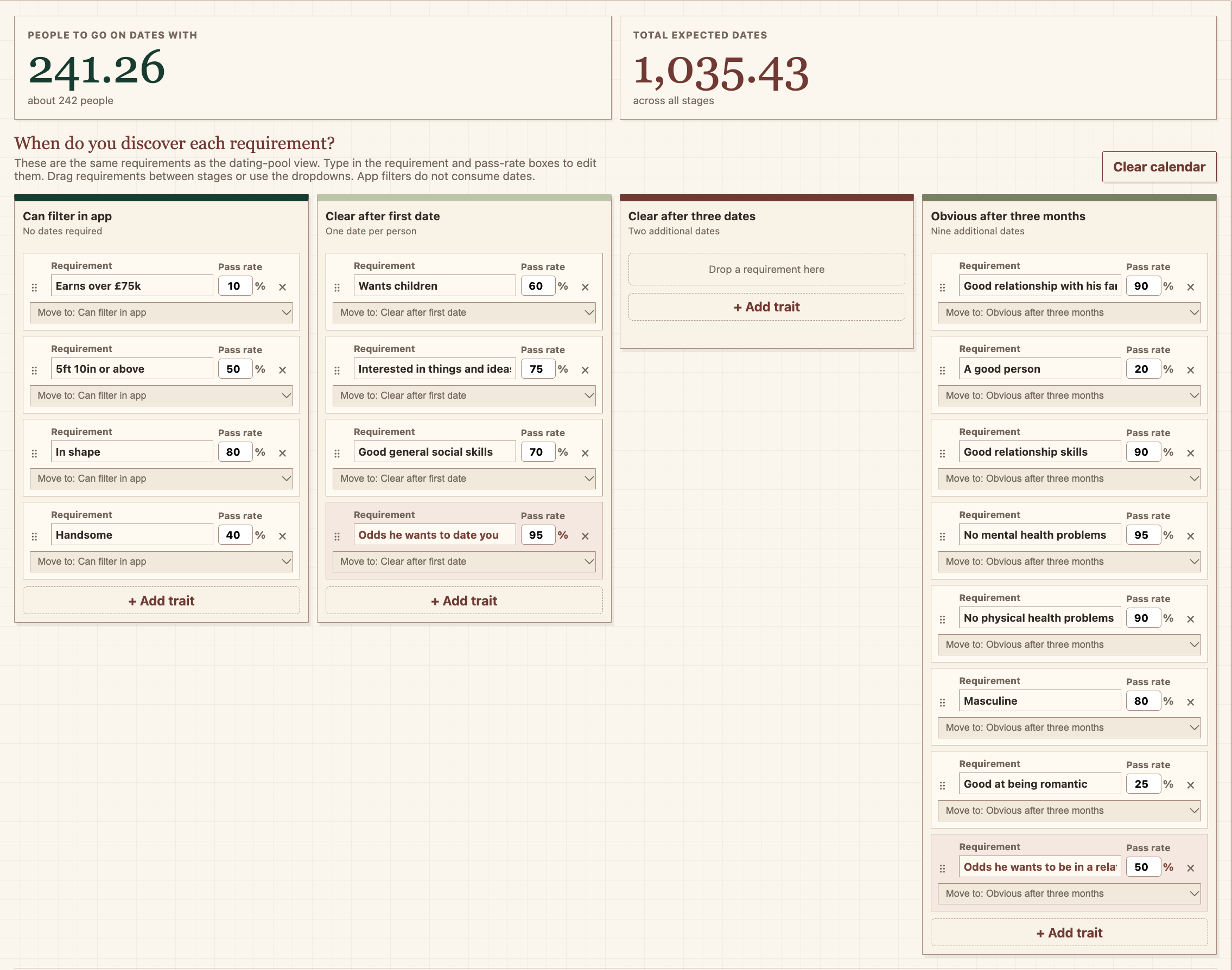
This means that while our toy standards are reasonable in the abstract, they don’t work in the real world. This is one of the great unfairnesses of dating. Wise and unmaterialistic people have to spend a lot of time finding out the quality of a person’s character whereas shallow and mercurial people can filter very quickly.
There are four things you can do.
Dealing with unrealistic expectations
1. Find proxies you can use to filter people out quickly.
If you want someone who is interested in things and ideas and who has a good set of social skills, you can decide to only go on a date with them if they have an interesting profile and good text chat. Of course, you’ll lose out on meeting a whole bunch of people who in reality meet all your standards, but you’ll waste less time overall. If you make that adjustment, you can boost your ‘interested in things and ideas’ from 75% to 90%, and ‘good general social skills’ from 70% to 90% as well.
I have a friend who wants to date someone with similar right-wing politics to her. I’m sure there are loads of men who are free-market curious who, terrified of the hordes of women who post memes like this

don’t put their politics on their profiles. Despite that, she’s made the decision to only date people who out themselves as moderates or conservatives on the apps.
2. You can draw information out of people.
If you’re paying attention, people confess their flaws all the time. My brain has an automatic filing system for the ways I expect them to disappoint me. When people tell me about how they slept with their best friend’s boyfriend or they called in sick for spurious reasons, I can’t help but catalogue it as a way they might let me down in the future. Maybe you can’t learn how to do this passively but you can do it proactively.
After a date think about the things he said and make notes against your criteria. Does he come across as responsible in his own anecdotes? When he talks about other people, does he condemn things that you consider morally outrageous?
You can also decide that you want to steer the conversation towards places that reveal more personal information. You can talk about their family, why their past relationships ended, what their fundamental ethics are etc. Self reports aren’t everything, because people view themselves through rose-tinted glasses (unless they are depressed) but if you’re listening, loads of people will admit to being emotionally unavailable, chronic cheaters, or addicts.
I think about 80% of people will give a good account of themselves so we can boost the odds they have a good relationship with family from 90% to 99%, that they’re a good person from 20% to 25%, that they have good relationship skills from 90% to 95%, and that they have no mental health problems from 95% to 99% as well.
3. You can become more desirable.
People I know are always undermining themselves. I’ve already written about how you can improve your looks. But there’s lots of low-hanging fruit out there.
There are lots of people I know where one trick would rapidly expand their dating pool. They could take a GLP-1, give up polyamory, stop identifying as asexual (even though they are open to having sex), get a job that doesn’t involve working evenings and weekends, soften their extremist politics, or dress normal. These things seem important to the people who do them, but from a third-party perspective they don’t seem worth the cost.
4. You can go on more dates
If your problem is that only a small proportion of men you go on dates with could plausibly be your husband, then you could just try to go on hundreds of dates.
5. You can lower your standards.
Usually when we talk about ‘delusion calculators’ and lowering one’s standards, we’re talking about shallow things like income and height. I would have been happy to marry an unattractive man if I was still marrying a good one.
But unfortunately whether he’s a good person who you can talk to for hours is also a ‘standard’ and it takes way more time to work out whether someone meets these standards.
This is why in 11 ways to arbitrage the dating market I say:
One of the great things about having friends, especially friends you’ve known for a long time, is that you know the content of their character. I have a few friends who are kind of weird, embarrassing and low status but they are really good people. Sure, they would be weird and embarrassing in a way that would embarrass you at parties but, except for that, they would make damn good husbands.
Don’t lose out on marrying a good man because you’re holding out for a handsome one.
But alas, we’re continuing with a toy model. Let’s start by re-crunching our numbers without lowering our standards. And for the model’s sake, let’s assume that becoming sexier and more appealing is impossible.
Clear before a date
Single man, aged 22-35
Good earning potential
5ft10
In shape
Handsome
Has an interesting profile and good in-app chat
Clear after one date
Wants children – 60%
Interested in things and ideas – 90%
Good general social skills – 90%
Clear after three dates
Self reported as a person with good ethics, relationship skills, and a good relationship with their family – 80%
You have to get to know someone to know (about 3 months of dating)
Good relationship with family – 99%
A good person – 25%
Good relationship skills – 95%
No mental health problems – 99%
No physical health problems – 90%
Has masculine virtue – 80%
Good at being romantic – 25%
This now means that 46% of first dates should progress to third dates, 80% of third dates should progress to serious dating, and 2.1% are husband material. Meaning that for one husband you need to go on 130 first dates, 60 third dates, and you need to seriously date 48 people.
This should take you 130+(60x2)+(48x9) = 682 evenings. (I’m assuming here that when you’re dating someone for the first three months you don’t see them exclusively and you try to see them about once a week.)
This would still mean having to go on 13 dates per week to find Mr Right in a year. It’s technically possible maybe, but necessitates a NEET and friendless state. So we have no choice but to lower our standards.
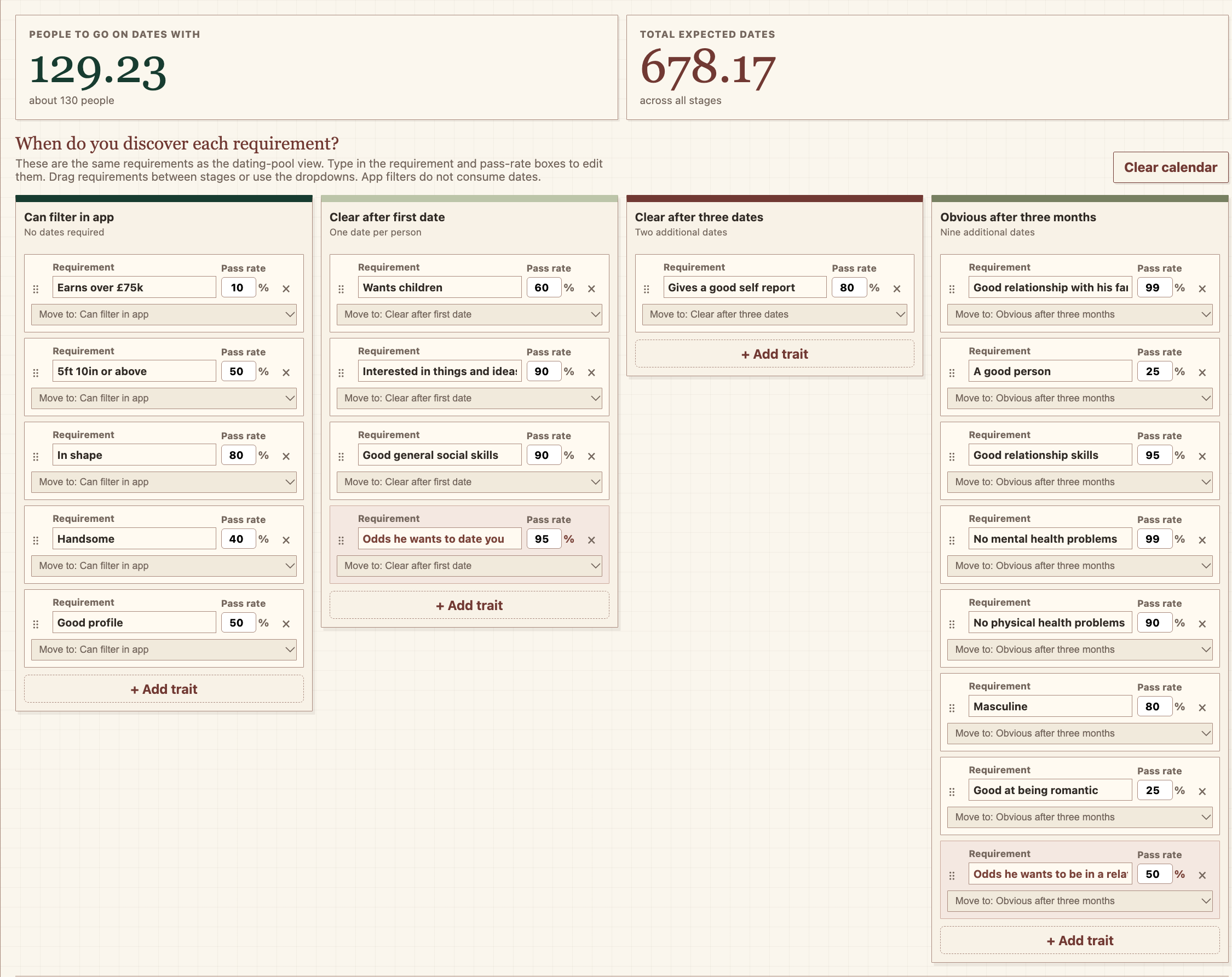
The most ‘expensive’ things on this list are whether they are a good person and whether they’re romantic. Let’s decide that we can live without romance and say they don’t need to be a super good person, just decent though. So that takes us from 25% to 66%.
With those adjustments, for every husband you find you need to go on 12 first dates, go on three dates with 6 people and seriously date five people for three months. This is totally manageable and only requires 65 total dates.
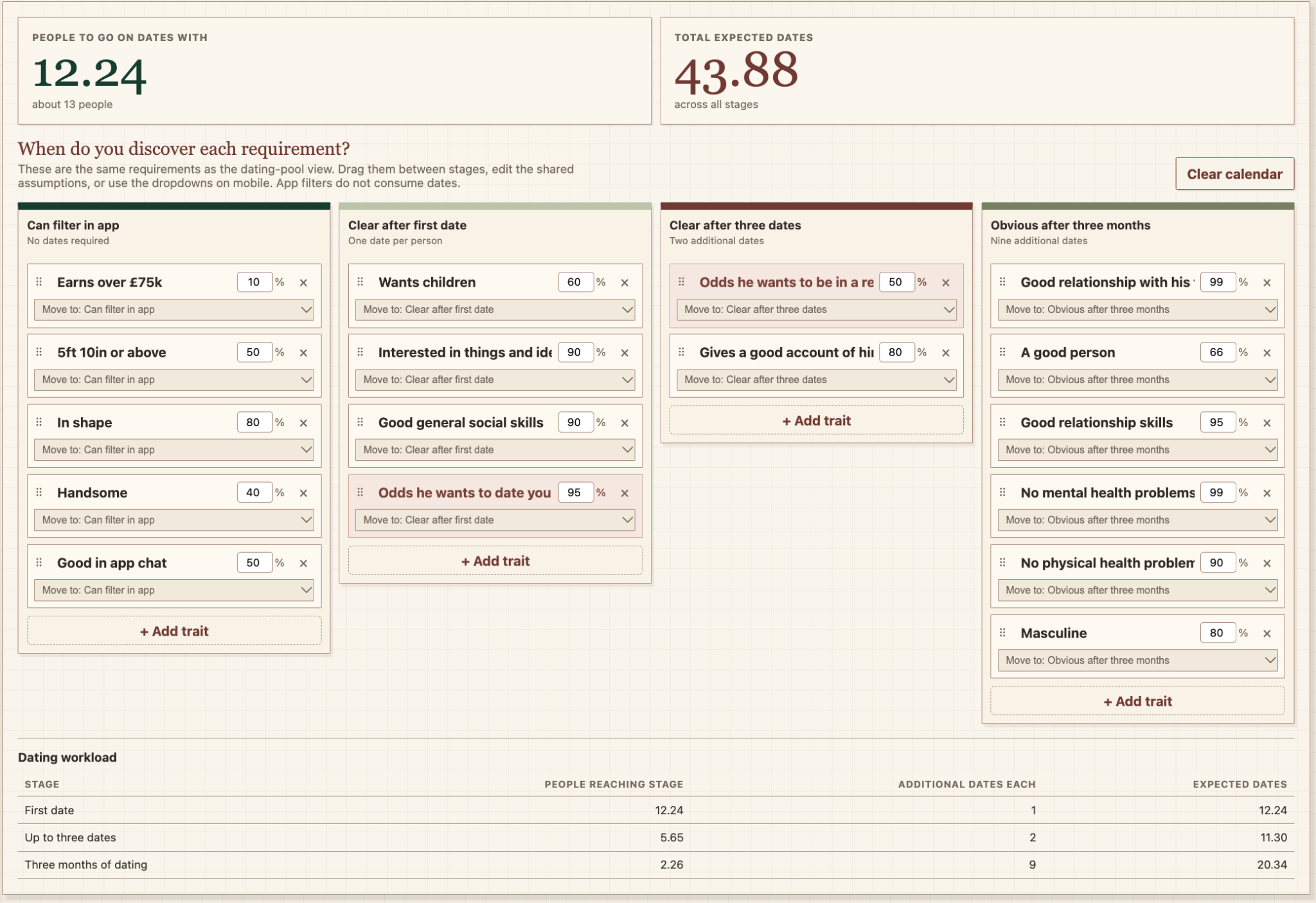
The next thing to decide is what odds do you want of finding your husband within the year? With these standards, each person you go on a date with has an 8.2% chance of being the one so you would need to go on about 2 dates per week to have a 90% chance of finding him. Or you can go on a date every other week to have a 50% chance of finding the one.
If you’re happy to go on more dates, you can afford to be a bit pickier with your standards. And if you’re finding that you’re getting more matches than you have time to date, you can be pickier about things like height, looks and income.
You’re telling me that after all that, I still have to go on two dates per week?
That’s the main thing people say after we go through my process. They’re upset that even after all that settling they still have to date like it’s their primary hobby.
People have very different social batteries and work commitments, but I consider three dates per week is the bare minimum for serious husband hunting. At my peak I was dating five people at once and that was excessive. I was struggling to make time for anything and I think the people I was dating could sense that I was somewhat detached. I’m hoping the fact I was difficult to make plans with gave the impression that I led a more vibrant and interesting life than I actually did.
You should be able to manage one date on a weekday evening, one on either Friday or Saturday night, and one on a weekend day. You should do these dates on top of going to parties where you might meet men. Frankly, if you don’t have time to do this, you don’t have time to be married. Forget about having and raising children.
If you’re under 22, I think you should use this time to just meet people and get to know them. If you’re 22 to 25, you should work out a dating calendar and standards that have you finding your husband in two-ish years. If you’re 25 to 30, try to find him in about a year. If you’re over 30, try to find him in six months.
Good luck out there.
Here’s the spreadsheet: https://docs.google.com/spreadsheets/d/1v7cFY31K7hUPv8jjxuHRilQdO7QyHM-ESuebU_j_5UA/edit?gid=0#gid=0
And here’s the website: https://dating-pool-field-notes.ariadbabu.chatgpt.site/
Chapeau for the enormous level of autism on display here.
To add my own autistic point, these frequently used (1/N)^n calculations are extremely stupid and wrong as the traits in question are clearly not independent.
It says a lot about the dating market that there's a 0.014% chance you'd want to date any particular appropriately-aged man in London and a 50% chance that that man you pick would want to date you.